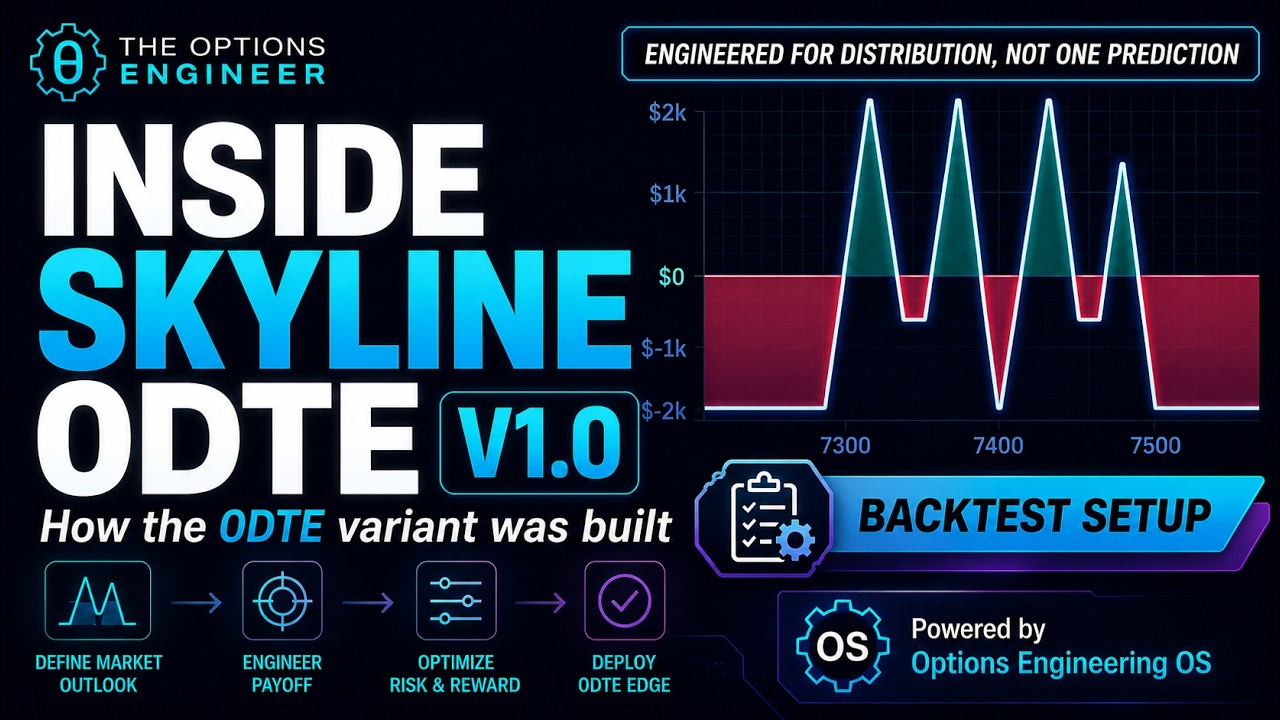
Backtested options structures, risk maps, and live trade lessons.
A practical research journal focused on defined-risk options engineering: SPX 0DTE spread variants, convexity maps, probability-weighted outcomes, and disciplined trade management.
Not signals. Structure design.
The focus is on designing option structures where the expected payoff is understood across a range of possible settlement outcomes — not predicting one exact market level.
Build the risk map
Map profit peaks, center valleys, outside-range risk, capital at risk, and payoff behavior before entering.
Test the distribution
Review how the structure behaves across flat days, controlled moves, trend days, gap filters, and real drawdowns.
Manage the path
Study when to hold, close, partially reduce, or flatten a valley without destroying the original edge.
Backtest research snapshot
The Option Engineer research process studies SPX 0DTE spread variants across different market regimes — inflation headlines, tariff risk, FOMC weeks, geopolitical volatility, trend days, and range-bound sessions.
The goal is not to rely on one exact market prediction. The goal is to engineer defined-risk convexity, understand the full risk map, and compare how different spread structures behave across real market conditions.
Research equity curve
Styled site view of the Extended Risk-Map Engine — a refined SPX 0DTE research model focused on payoff coverage, capital-at-risk efficiency, drawdown behavior, and live manageability.
OptionOmega backtest snapshot
Platform snapshot shown for research validation. Strategy mechanics, strike logic, sizing rules, and adjustment details are intentionally not displayed.
Volatility Range Engine
A baseline spread-variant model tested across 2024–2026 volatility, tariff, headline, inflation, and FOMC-style regimes. Strong return profile, but higher drawdown led to further refinement.
Extended Risk-Map Engine
A refined version focused on wider payoff coverage, convexity balance, capital-at-risk efficiency, drawdown behavior, and live manageability.
Regime Sensitivity Model
A variant used to study why some structures work better in one volatility or trend environment than another, reinforcing regime-aware structure selection.
Backtested/hypothetical research result. Results depend on assumptions including fills, slippage, commissions, liquidity, execution timing, volatility, and market regime. This is educational research only and is not financial advice, a trade recommendation, or a guarantee of future performance.
Forward-tested against live market behavior
The backtest research is also being compared against live market behavior through a structured trade journal.
Over the recent two-week period (Jun 14 to Jun 27), live SPX spread-variant results were journaled and compared against the same risk-map framework used in the backtest research.
The live results have been broadly consistent with the research framework and with related strategy variants, while also highlighting areas where structure design and trade management can be further refined.
The objective is continuous improvement: using backtesting and forward testing to make the structures more predictable, improve risk-zone awareness, and reduce discretionary decision-making over time.
Live journal notes are summarized at a high level to protect strategy mechanics, sizing rules, strike logic, and adjustment details.
Systematic trade management
The research process is supported by a custom risk-map workflow used to model, track, and review SPX spread variants.
The trades themselves can be placed through standard options brokerage platforms. The workflow is not intended to replace a broker or require a special execution platform. Its purpose is to help make the research and trade-management process more structured.
It helps translate complex option behavior into clearer decision points: capital at risk, payoff zones, convexity exposure, live P/L movement, and expiration-risk awareness.
The objective is to reduce emotional decision-making, improve risk-map awareness, and continue refining the structures based on both backtested research and live-journaled behavior.
Interested in a strategy review?
I’m open to discussing SPX and index-options structures, backtest methodology, and risk-map based trade management.
Educational content only. Nothing on this site is financial, investment, tax, legal, or trading advice, and nothing is a recommendation to buy, sell, or hold securities, futures, options, or any other financial instrument. Options involve risk and may not be suitable for all investors. SPX 0DTE and short-dated options can lose value quickly and may result in substantial losses. Backtests, normalized graphs, examples, screenshots, and hypothetical results are for research and education only and can differ materially from live results due to fills, slippage, commissions, liquidity, volatility, execution behavior, and market conditions. Past performance, whether backtested or live, does not guarantee future results.
The Option Engineer is a research journal and educational brand. All content, concepts, text, graphics, examples, and site materials are © The Option Engineer. All rights reserved. Unauthorized copying, redistribution, or commercial use is prohibited without written permission. Third-party names, tickers, indexes, and trademarks belong to their respective owners. The Option Engineer is not affiliated with or endorsed by Cboe, S&P Dow Jones Indices, Standard & Poor’s, Discord, or any brokerage platform.